Generative AI is no longer a side project in ecommerce. In 2026, it is becoming an operating layer across discovery, conversion, support, and merchandising.
The teams seeing real gains are not "using AI everywhere." They are using it in a few high-impact workflows, measuring lift every week, and scaling only what improves margin.
Why this matters now
Three shifts are happening at the same time:
- customer acquisition is more expensive, so conversion efficiency matters more
- content volume requirements are rising across channels
- support expectations are now real-time and multilingual
Generative AI helps when it is tied to business outcomes, not novelty.
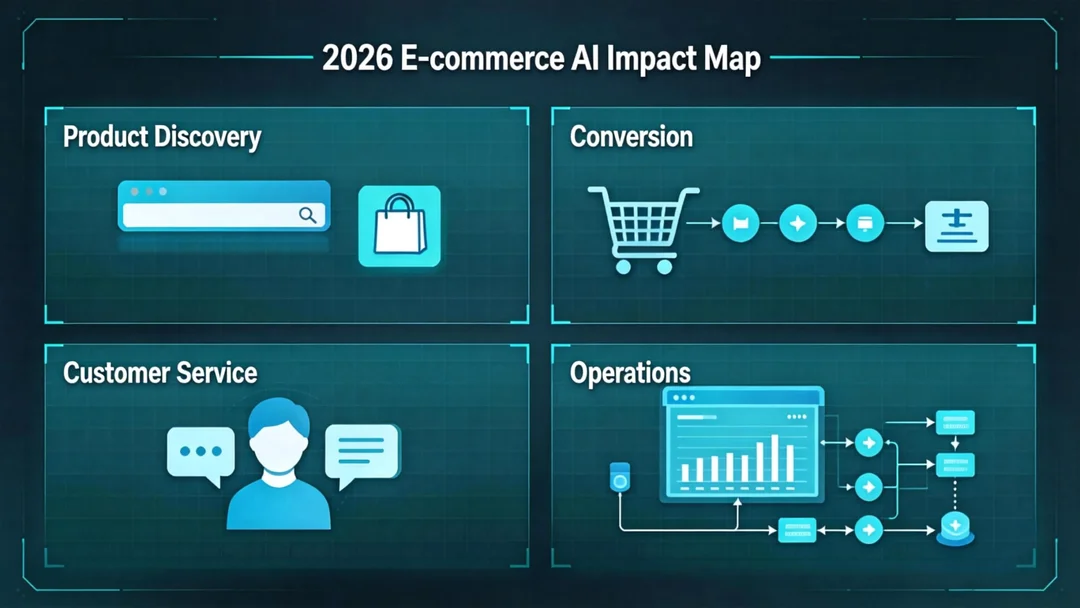
What generative AI changes in ecommerce
1) Faster product discovery and better merchandising
Traditional search and category pages are static. Generative AI makes them context-aware:
- query understanding improves for natural language shopping intent
- dynamic product explanations reduce confusion before checkout
- AI-assisted merchandising creates more relevant product paths
Result: more qualified sessions reach product detail pages and add-to-cart.
2) A content engine instead of one-off content tasks
Most ecommerce teams lose time rewriting the same thing for different channels. Generative AI can produce structured variants from one source:
- product titles and descriptions by channel and audience
- ad copy and email variants for rapid testing
- FAQ and comparison content that supports SEO and conversion
Result: lower content production cost per SKU and faster campaign launch cycles.
3) Support automation that actually converts
GenAI support is moving from simple FAQ bots to revenue-aware assistants:
- pre-purchase guidance by budget, use case, and compatibility
- post-purchase automation for shipping, returns, and status updates
- multilingual support without linear headcount growth
Result: lower ticket cost and higher assisted conversion.
4) Better decision-making in planning and inventory
Generative AI is also useful behind the scenes:
- summarizing demand signals from multiple systems
- turning forecast outputs into plain-language action plans
- helping teams prioritize replenishment and markdown actions
Result: fewer stockouts, less dead inventory, and better cash use.
Where cost savings usually come from
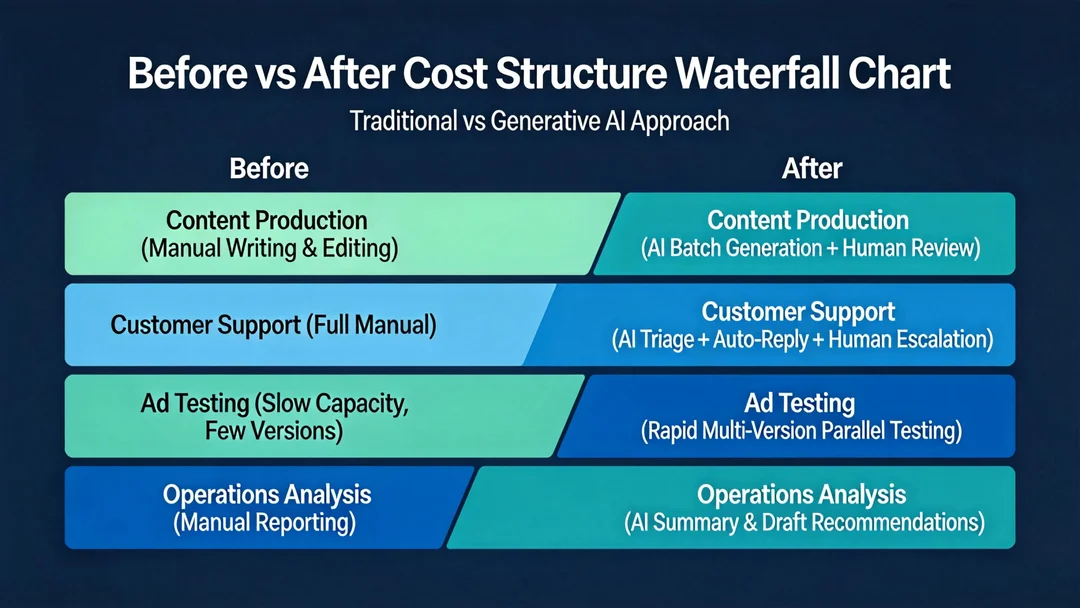
Cost savings come from system-level workflow compression, not from one model call.
| Cost center | Before | With generative AI | Typical impact |
|---|---|---|---|
| Product content | Manual writing and rewrites | AI-assisted multi-variant generation + editor review | Lower cost per SKU update |
| Customer support | Fully human first response | AI triage + automated answers + human escalation | Lower cost per ticket |
| Campaign production | Long creative cycle | Fast draft-to-test loop with AI variants | Lower testing cost, faster winners |
| Merchandising ops | Manual analysis | AI summaries and recommendation drafts | Faster decision cycles |
How to use generative AI in ecommerce: practical rollout
Phase 1: Pick two KPI-linked workflows (Weeks 1-2)
Choose one conversion KPI and one cost KPI first.
Example:
- conversion KPI: add-to-cart rate on top 200 SKUs
- cost KPI: support cost per resolved ticket
Do not start with ten tools. Start with two workflows tied to measurable outcomes.
Phase 2: Build controlled experiments (Weeks 3-6)
Run A/B tests with guardrails:
- AI-generated product copy vs current copy
- AI-assisted support responses vs manual-only responses
- AI-personalized merchandising blocks vs static blocks
Track lift, errors, and rollback paths.
Phase 3: Scale by playbooks, not prompts (Weeks 7-12)
Convert winning tests into repeatable templates:
- prompt patterns by category
- review checklist by risk level
- publishing workflow with role ownership
At this stage, operational discipline matters more than model choice.
AI video in ecommerce: where it fits and why it pays
Video is one of the largest hidden costs in ecommerce growth teams. Generative AI video reduces production friction in three places:
- rapid ad creative iteration
- product explainers and demo clips
- localized variants for different regions and audiences
A practical approach is to test multiple models on the same brief, then keep the winner by CTR, CPA, and watch-through rate.
Use Genverse AI for ecommerce video testing
Create Product Videos from Images
Build Consistent Videos with Reference Clips
Common mistakes to avoid
- launching AI without baseline metrics
- measuring output volume instead of margin impact
- skipping human review for high-risk copy and policy-sensitive responses
- using one generic workflow for every product category
What "good" looks like after 90 days
By day 90, a solid implementation usually looks like this:
- measurable lift in conversion on priority pages
- lower support cost on repetitive intents
- faster campaign testing cycles
- clearer inventory action plans from AI-assisted analysis
If those four outcomes are not visible, simplify the stack and tighten KPI ownership before adding more tools.
Final takeaway
In 2026, generative AI in ecommerce is not about replacing teams. It is about compressing work between idea and execution.
Start with workflows that touch revenue and cost at the same time: discovery, support, and campaign content. Then scale what proves itself in weekly numbers.